REM 7: More Options. More Pressure. More Strategy

A Market in Transition—and Why Strategy Now Matters More Than Ever
Recent national reporting suggests that renters are experiencing a modest but meaningful degree of financial relief, with estimates indicating approximately $2,300 in annual savings driven by increased inventory and stabilization in rental pricing. While such figures offer a useful macroeconomic snapshot, they risk overstating the degree to which national trends translate into local outcomes. In residential real estate, broad indicators rarely determine results. Those remain firmly rooted in local market conditions and, increasingly, in the structure of individual transactions.
The current housing environment is best understood not as a downturn, but as a transition. The urgency that defined the supply-constrained markets of recent years is giving way to a more measured, decision-oriented phase. Inventory has begun to rise incrementally, and while prices have largely stabilized, buyer behavior has shifted. Purchasers are more selective, more analytical, and less inclined to compete aggressively without clear justification. At the same time, sellers are encountering a more competitive landscape in which pricing discipline and property presentation carry greater weight. In this environment, transactional outcomes are less dependent on timing and more dependent on execution.
The divergence between regional markets further complicates any attempt to generalize. In Oregon, for example, inventory has increased but remains comparatively constrained. Prices have shown resilience, softening only in select segments rather than across the board. Buyers in these markets are more deliberate, often attaching conditions that reflect a heightened sensitivity to value. Sellers, in turn, are finding that success hinges on precise pricing and well-prepared properties. The market is moving toward balance, though it continues to exhibit characteristics of limited supply.
By contrast, markets such as Illinois present a different profile. Inventory levels are higher, price growth is more tempered, and affordability is shaped not only by home values but by the significant role of property taxes. Buyers tend to operate on longer timelines, weighing payment structures and long-term costs with greater caution. These conditions produce a more traditional market dynamic, in which negotiation and patience are integral to the process.
This contrast underscores a central principle: real estate markets are inherently local, even when influenced by national forces. Interest rates, inflation, and broader economic trends establish the framework within which transactions occur, but they do not dictate individual outcomes. Those are determined by localized supply and demand, as well as by the decisions made within each negotiation.
In the current environment, the structure of a deal has emerged as a primary determinant of success. Counteroffers, once viewed simply as a response mechanism, now function as iterative tools that allow both sides to recalibrate expectations around price, timing, and risk allocation. They are less a sign of disagreement than a structured continuation of negotiation. Addendums operate at a more refined level, enabling parties to address inspection findings, adjust financial terms, and clarify possession details without disrupting the broader agreement. Together, these instruments provide the precision required to navigate increasingly complex transactions.
Consider, for example, the inspection phase, where friction often arises. A buyer may present a detailed list of repair requests, each of which introduces potential delay and uncertainty. An alternative approach—requesting a lump-sum credit in lieu of repairs—can streamline the process. Such a strategy reduces complexity, accelerates agreement, and provides flexibility for the buyer after closing, all while increasing the likelihood that the transaction will reach completion.
The housing market today is defined less by volatility than by recalibration. As inventory expands and options increase, the advantage shifts toward those who can interpret conditions accurately and respond with deliberate strategy. In this context, success is no longer driven by speed alone, but by the ability to structure agreements that align the interests of both parties while minimizing friction.
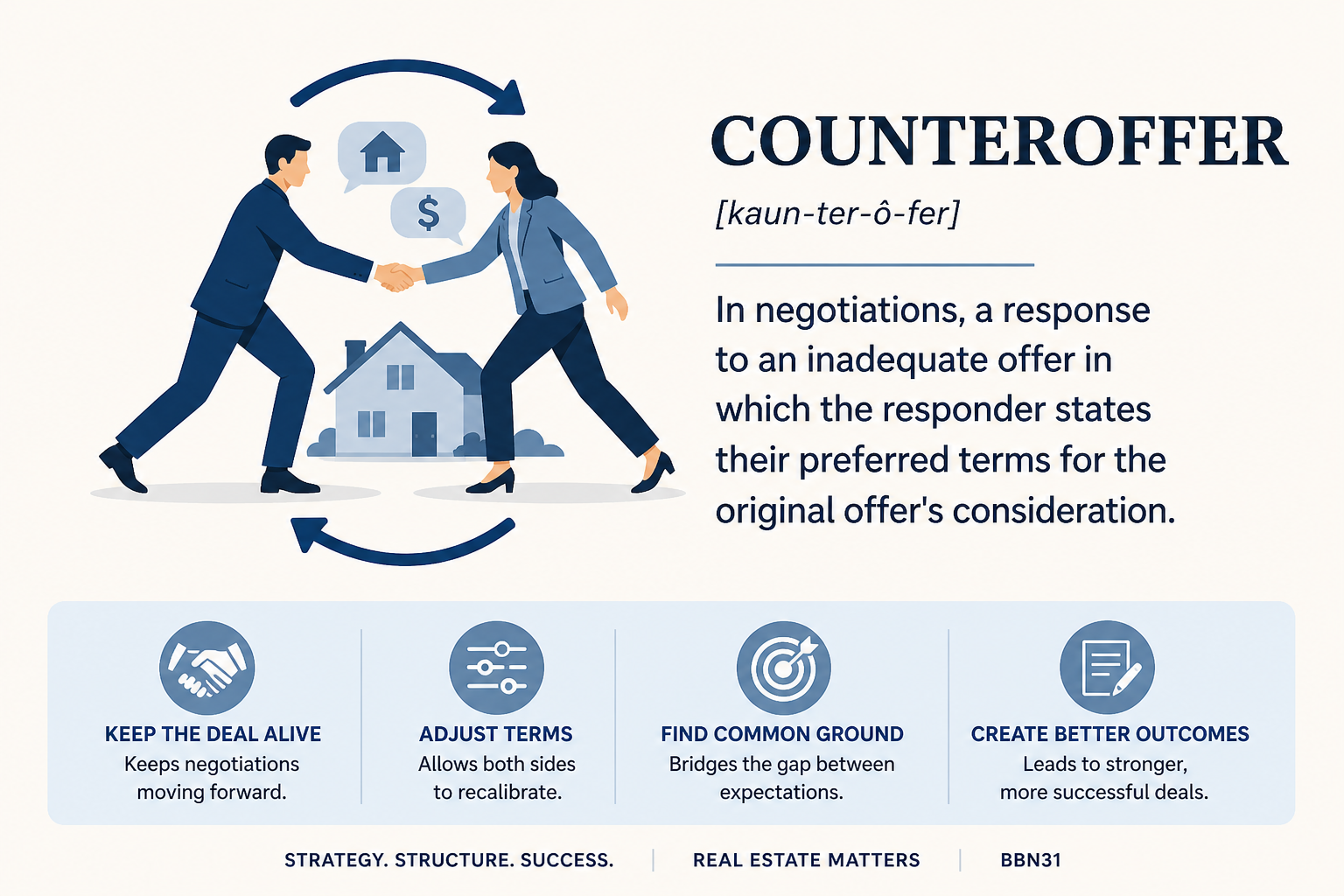
Those who understand how to deploy tools such as counteroffers and addendums effectively are not merely reacting to the market. They are shaping outcomes within it.
Real Estate Matters — BBN31
Broadcasting What Matters